
The Audience Ladder: How Emotion Moves Audiences
Audience Reality Check #8
A film can be available everywhere and desired nowhere.

Photo by Sergei Nikulin on Unsplash
We keep mistaking access for audience. When a film is finished, listed on a platform and scheduled for a handful of theatrical or festival screenings, the industry assumes an audience opportunity has been created.
But making a film available merely solves a logistical problem. It tells us that people can watch it. It does not solve the emotional, cultural or behavioural problem of getting a human being to care enough to choose it.
That distinction matters in an environment where audiences face an overwhelming supply of screen stories, social content, games, podcasts and other demands on their limited attention. A film is not only competing with other films opening on the same weekend. It is competing with every other possible use of someone’s time, money and emotional energy.
To move people from passive awareness toward meaningful choice and connection, we need to understand how audiences actually travel. We need to understand the Audience Ladder.
Introducing the Audience Ladder
The Audience Ladder is a diagnostic framework, not a rigid sales funnel. Audiences do not always move neatly through every rung. A trusted recommendation may propel someone quickly from discovery to choice. Another person may encounter a title repeatedly without ever understanding why it might matter to them.
Different projects also require different outcomes. A commercial comedy may prioritize attendance and word of mouth, while a documentary may seek discussion, learning or public action. A community screening may place greater value on the relationships formed in the room. A filmmaker building a sustainable career may care most about whether audiences remember the work and themselves and return for the next project.
The ladder helps identify where audience movement is happening and where it may be breaking down.
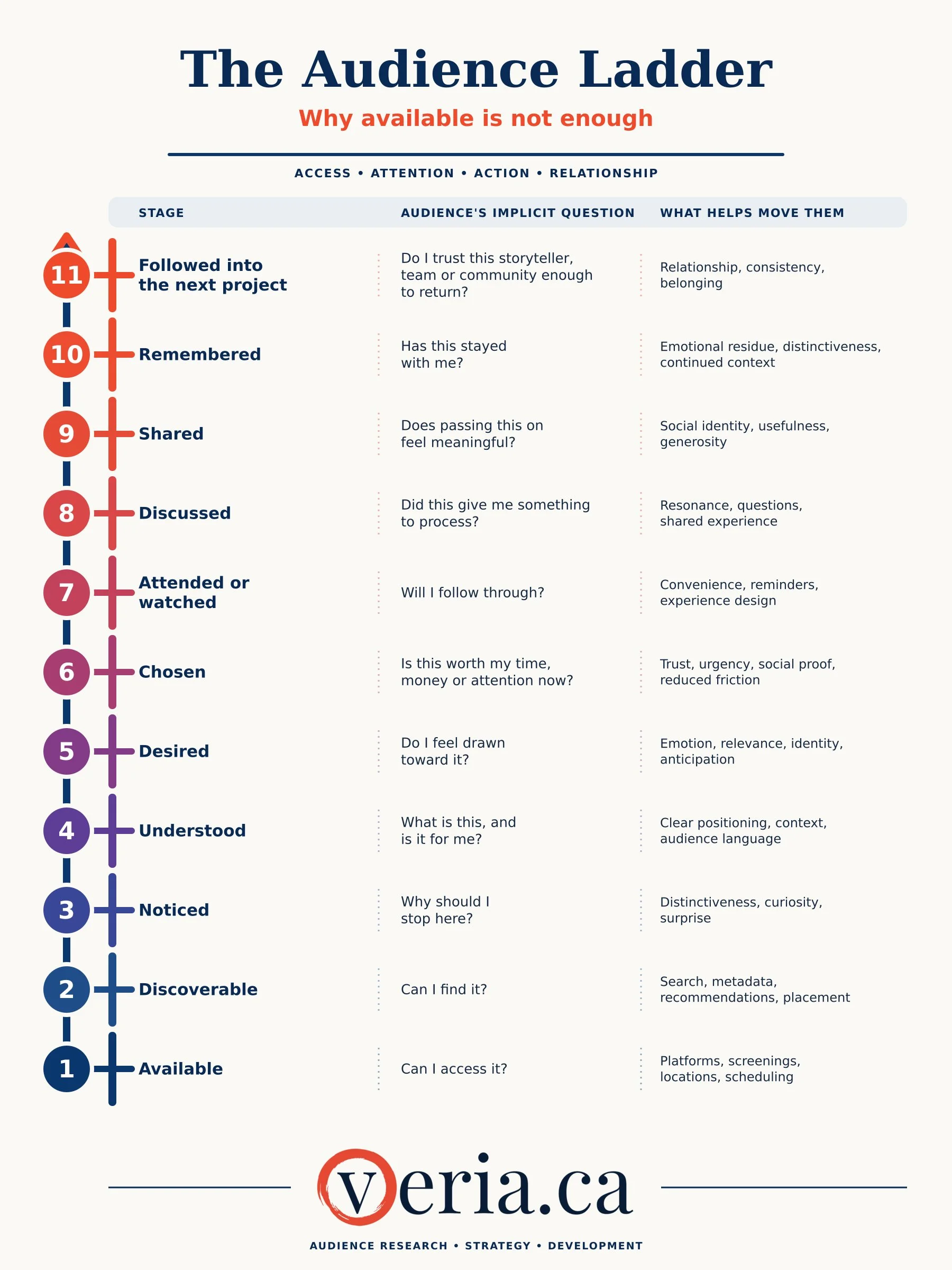
Each rung represents a different audience hurdle. A film can be discoverable without being noticed. It can be noticed without being understood. It can be understood perfectly well without being desired. Someone can even desire a film in the abstract but not choose it tonight. Yet we often compress all this work into the broad category of “marketing” and expect a trailer, media buy or platform placement to solve every problem at once.
It cannot.
Before the Human Audience: The Machine Audience
Before a human being can discover a film, a largely invisible intermediary must often be able to find and interpret it first. Search engines, streaming interfaces, recommendation systems and AI answer tools need structured, reliable information to identify what a film is and where it can legally be watched. Clean metadata, consistent credits, authoritative source pages and accurate where-to-watch information are therefore foundational audience infrastructure. While incomplete, contradictory or poorly structured information can prevent a film from being accurately indexed, surfaced or matched with relevant searches and recommendations.
However, the best machine legibility cannot create human emotion.
Emotional Marketing to Humans
Emotion in film marketing is sometimes misunderstood as cheap melodrama, manipulation or manufactured urgency.
In reality, emotional connection can be much quieter and more varied. It may begin with curiosity about something unfamiliar, recognition of a place or lived experience rarely seen on screen, or the pleasure of feeling understood. It can take the form of delight, anger, longing, reassurance, fear or wonder. Sometimes the draw is more social: the sense that this story was made with people like me in mind, or that watching it will allow me to join a conversation or shared experience I value.
A trailer, poster, interview, community partnership or social post are therefore not simply vehicles for delivering facts. They are invitation to anticipate an experience. The most effective audience development and engagement materials do not merely explain what happens in a film. They make the film’s emotional promise visible.
The Neglected Rung: Desire
The screen sector talks constantly about discoverability. We want Canadian films to be available on more platforms, surfaced more prominently and easier to find. These are important goals. But discoverability does not answer the question of why an audience would want what it finds.
We often jump directly from findability to attendance, as though making a film visible will naturally make it chosen. Between those outcomes lies a massive and frequently neglected gap: desire.
A project may have clean metadata, strong platform placement and broad awareness while still failing to answer the questions running through a busy potential viewer’s mind: Why this story, why me, why now and why should I choose it over everything else I could watch or do?
A synopsis rarely answers those questions on its own. A synopsis tells us what happens, but it does not necessarily tell us what the experience will mean to the audience. “Generational conflict in a modern family” might accurately describe hundreds of films. It tells us little about what this specific film will make us feel, recognize, question or experience together.
When a film fails to find its audience, the problem is not necessarily the film itself. It may be that the release never made the film’s emotional promise visible to the people most likely to value it. Desire rarely materializes on command during one frantic week of promotion. It must be cultivated.
An Audience Is Not a Demographic Category
Part of the problem is that we often define audiences too broadly. “Adults aged 25 to 54” is not an audience strategy. Neither is “women,” “young people,” “film lovers” or “the general Canadian public.” These default demographic categories may describe a potential market, but they do not explain why someone will choose a particular story. Two people of the same age, gender and location may respond to completely different emotional promises. People make choices through a mix of identity, taste, mood, values, relationships, circumstances and prior experiences.
A useful audience hypothesis therefore identifies the people most likely to recognize something meaningful in the work, the conversations they are already having and the value the film may offer them. It considers the pleasures, tensions or sense of belonging embedded in the experience, as well as the people, organizations and communities that audience already trusts. Most importantly, it explains what could make watching, attending or sharing feel personally worthwhile.
This is the difference between identifying people who theoretically could watch a film and understanding the people most likely to care.
The Work Continues After the Credits
Traditional release thinking often treats viewing as the final transaction. The ticket was sold. The stream was counted. The campaign is complete. But watching is only one rung on the ladder.
The deeper value may emerge in what follows: a conversation, a recommendation, a repeat viewing, attendance at a related event or a decision to seek out more work from the same filmmaker. A film may become part of an ongoing community discussion, remain emotionally vivid months later or create enough trust that an audience is willing to return for the next project. Discussion, sharing, memory and follow-through are where an isolated viewing can become a lasting relationship.
This is one of the clearest lessons the legacy screen sector can learn from the digital creator economy. Successful creators do not treat every video, podcast, newsletter or live experience as an entirely separate promotional transaction. Their work becomes part of an ongoing relationship with an audience. People return because they recognize a voice, perspective, sensibility or community. Trust carries forward from one piece of work to the next.
Film, by contrast, is frequently financed, produced and released as a series of disconnected one-offs. The project ends, the team disperses and the audience data often remains with platforms, distributors or exhibitors. The next film begins by rebuilding attention from zero. That is not sustainable audience development. It is recurring audience amnesia.
Sustaining a creative career requires ways to retain and deepen audience relationships beyond a single release. Newsletters, owned websites, community partnerships, events and social channels can all provide points of continued connection. These are not simply promotional expenses. They are enterprise infrastructure that can accumulate value over time.
What The Audience Ladder Changes
Once we recognize that audiences move through distinct stages, audience strategy becomes more precise.
For filmmakers and producers, the work begins with identifying the emotional promise of the story early enough to influence positioning, partnerships and the materials created around it. This does not mean making creative decisions by committee or chasing whatever appears most commercially popular. It means understanding who the work may matter to and why. Audience strategy should clarify the connection the creative team hopes to create, not dilute the qualities that make the work distinctive.
For distributors, the ladder offers a way to diagnose the actual problem before reaching for more advertising. A visibility problem requires a different solution from an understanding problem. A film that is widely known but weakly desired may need clearer positioning, stronger context, different partnerships or a more compelling invitation rather than another round of impressions.
For exhibitors, the framework reinforces the value of physical spaces as hubs for community, context and shared experience. Cinemas and other community spaces cannot always compete with the living room on convenience. They can offer occasion, presence, conversation and the feeling of participating in something with other people. The challenge is not only bringing audiences into a building. It is making the act of gathering worthwhile.
For the wider sector, the ladder also provides a more useful way to learn from releases. Each campaign can help reveal where audience movement stalled, which interventions helped it resume and which partnerships created trust. Over time, this evidence can help distinguish a discoverability problem from a positioning problem, a desire problem or a relationship problem.
That learning should not disappear when the campaign ends. Each release should contribute to a shared body of knowledge about how different films connect with different audiences under different conditions.
Without that learning layer, every film remains an isolated experiment. The same assumptions are made repeatedly while valuable knowledge disappears when the project ends.
Building the Whole Ladder
Canada does not simply need more film marketing. It needs audience infrastructure. That infrastructure includes research, data, training, direct audience relationships, trusted community pathways, knowledgeable exhibitors, flexible release strategies and systems that allow learning to carry forward from one project to another.
It also requires a richer shared vocabulary. When we describe every audience challenge as a discoverability problem, we reach too quickly for the same limited solutions.
A film may need to become easier to find, easier to understand or more emotionally legible. It may need a more distinctive invitation, stronger context or time to build trust before an audience will choose it. And the work after the viewing may matter as much as the work required to secure it.
If we want Canadian cinema to build lasting cultural and economic value, we need to stop treating availability as the finish line. A film becomes meaningful to an audience through the accumulation of reasons to notice, understand, desire, choose, discuss, remember and return.