
Audience Reality Check #13

Photo by Serj Sakharovskiy on Unsplash
In June, when Ottawa announced an annual $600 million to stabilize Canada’s audiovisual sectors, I asked whether any of that investment would strengthen the connection between Canadian stories and the people who might care about them. Five months later, that question has become much more practical.
On November 8, the government outlined how it will distribute the money, including $213.4 million for the Canada Media Fund, $68.5 million for Telefilm Canada and $51 million for the Indigenous Screen Office. These allocations cover the 2026-27 fiscal year, which implies it needs to be moved before the end of March 2027 (just a few short months away!). There’s a risk that pressure to move quickly will favour existing production envelopes and programs. That is why audience work cannot be an afterthought; it must be a deliberate, non-negotiable priority for this investment.
Audience work needs stability too
The relief across the industry is understandable. People need work. Productions need financing. The Writers Guild of Canada and AQPM have welcomed the support while continuing to call for predictable funding and binding contributions from streamers. Those needs remain.
However, the people bringing Canadian work to audiences also need enough stability to keep doing it. An independent cinema needs someone to program its screens and understand its local audience. A community screening network needs time to work with hosts. A producer maintaining an audience channel needs someone who can respond when people show up.
There’s room for this work in the announcement. Telefilm has explicitly named audience connection as a priority. Heritage’s direction for CMF includes promotion and distribution, alongside business development. This language gives us something to work with. As the funding takes shape, I’d like to see five priorities given a clear place.
1. Help the industry put audiences into practice
This investment opens a longer conversation. What are we asking people to do when we ask them to be audience-centric, and are we giving them the means to do it?
In the past, I provided alternate distribution and marketing training through Telefilm’s Microbudget program (now Talent to Watch) and helped many projects build unconventional audience-centric plans. I recently learned that many of these filmmakers still chose familiar release paths (festivals > distributor > limited theatrical > maybe broadcast/streamer licenses). That’s understandable when funding rewards conventional release paths and film schools reinforce them as the measure of a filmmaker’s success.
An audience-centric approach requires an industry-wide foundational shift. Funders can begin changing that through practical training and application criteria that recognize different audience pathways. Support should start while projects are still in development, with funding for research and release planning. Pay filmmakers to participate alongside experienced advisers and distributors, so the team members understand the decisions and are invested in carrying them out.
Established companies may need a convincing reason to change practices around which they’ve built their businesses. Funders could involve them in developing workable criteria and give credible experiments a fair chance of support. Funding officers and assessors also need the knowledge to evaluate those proposals. If audience connection is becoming a funding priority, people need to see how it changes an application and the decision that follows. That’s how the language can begin to change the work.
2. Help existing work reach people
However, some Canadian films are finished and ready to meet an audience today. Others have completed an initial release and could travel further with the right partners. Further circulation should be eligible for support, including the planning needed to identify those opportunities.
Completed films may already have audience learning to build on. Teams that have tested screenings or different invitations may know who responds to the film and where their approach needs work. Funders should recognize that evidence when assessing further support, including what an unsuccessful attempt helped the team understand.
3. Pay for the relationships
I’m not talking about ads here. Audience development takes people. Someone has to identify and approach a community partner, understand what they need and follow through after the screening.
There are examples to build on already:
NICE’s recent Market Access Barriers research examines how independent cinemas make booking decisions. It brings attention to the work that happens before a film reaches a screen, when programmers decide what they can offer their audiences.
And through my recent work with the impact producing charity Story Money Impact, I’ve seen how much time goes into finding relevant screening hosts and helping them bring people together. Maintaining those relationships takes work long after the initial introduction.
Make that staff time eligible for support, including within the organizations hosting and coordinating screenings. Where the funding terms allow, support audience roles across several releases. Experience gained on one film becomes more useful when someone is still there to apply it to the next.
4. Make the invitation easier to accept
People need accurate information about where and when they can watch. They also need to know whether the experience will be accessible to them.
Fund reliable availability information and access materials as part of the release. Captions and clear venue information matter. For some community screenings, transportation may be the difference between an invitation and an opportunity to attend. Better metadata can also help Canadian work appear in search and discovery systems. Funders could support improvements to existing catalogues and release information, with practical guidance that smaller teams can use.
As I argued in the Audience Ladder, being found is just one part of the journey. People still need a reason to choose the work. The invitation needs to help them understand why this particular Canadian story is worth their time.
5. Make the learning available
Every supported release is an opportunity to understand something about audiences. How did people learn about the film? What helped turn interest into a decision to watch? Where did that connection break down? What happened after people watched? Did they stay in touch with the filmmaker or host?
Include research and evaluation time in release budgets, with a requirement to share useful findings. Someone needs paid time to determine the right questions and examine the answers. Reporting should be manageable, and the findings should be available in a form another team can apply. An honest account of an unsuccessful approach can save someone else time and money. The National Audience Data Consortium is already examining the sector’s audience data practices and capacity, with findings expected in early 2027. Funded release research could contribute practical experience to that wider work.
What could this look like?
Imagine…
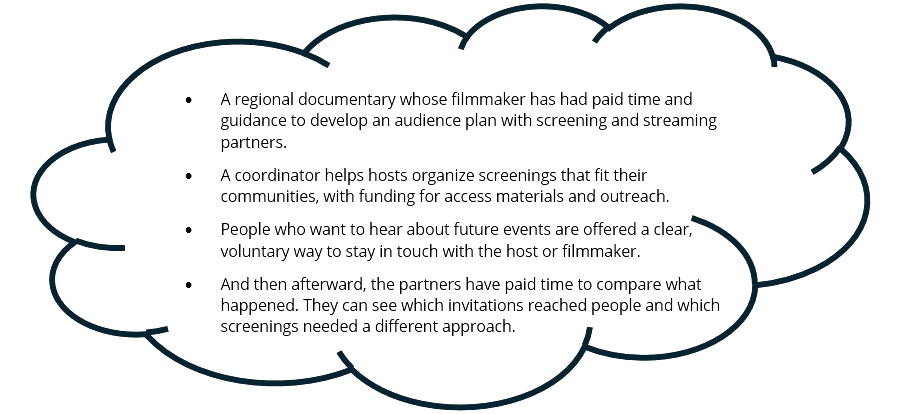
Maintaining those connections and putting that knowledge to use takes resources. Shared learning gives the next release somewhere to begin, with a better understanding of what helped people attend or watch.
So as funders consider proposals and applications, I’d challenge them to ask this practical question:
What will this investment enable the storyteller and their partners to do better for audiences on the next project?
We should be looking for ways to build lasting audience infrastructure and pathways to maximize this public investment. This question is a potential entryway into this kind of thinking for funders, filmmakers and the whole screen media ecosystem.
The money is coming. This is our moment to give audience connection a defined place in the budget, with people paid to make it happen.